
Upcoming Film
Online ticket sales will end at 5:00 pm on February 25. Additional tickets will be available at 7:30 when doors open.
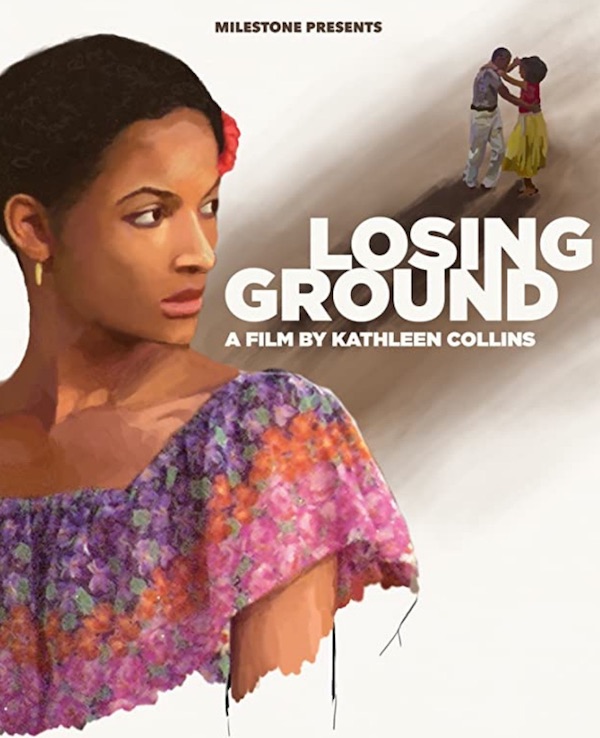
Losing Ground was one of the first feature films made by a Black woman. Her name is Kathleen Collins (1942 – 1988), and she lived in Piermont and in Nyack, where she raised her children until her life was cut short way too soon.
This special screening will include a discussion with Nina and Emilio Collins, the daughter and son of Kathleen Collins, moderated by filmmaker Liani Greaves.
Just added: all the love i could hancle, a 14 minute film by Kathleen Collins’ grandaughter (daughter of Nina, niece of Emilio) that is a poetic reimagining of her mother’s memory of an incident on the day that Kathleen Collins finished Losing Ground in 1982.
In 2015, Kathleen Collins’s daughter finished restoring her writings, plays, and films. This was quickly followed by the international aclaim that Kathleen Collins should have received in her lifetime but sadly did not. Rivertown Film is excited to present Losing Ground in a rare screening, a few miles from Kathleen Collins’s home, as one of our 25th Year Special Events. Richard Brody wrote in The New Yorker, “had it screened widely in its time, it would have marked film history.” Instead, it took decades before it received that recognition.
Losing Ground upends the stereotype of black American life in the 1980s, when it was made. The main characters are Seret Scott’s philosophy professor (loosely based on Collins’s own experiences) and her abstract painter husband played by Bill Gunn (Ganja and Hess), a Rockland County neighbor who, like Collins, also received more acclaim decades after he died than when he was alive. He declares himself, with irony, “a genuine Black success” after selling a painting to a major museum, and decides the couple should leave New York City and head off to the country for the summer, picking Haverstraw because he feels drawn to the landscape, the light, and “those Puerto Rican ladies.” This sets off an existential crisis for Scott’s character. Watching it is pure pleasure for anyone who enjoys grappling with issues of representation and art, exclusion and appropriation, abstraction and narrative, intellect and emotion, feminism and race, human development and aging.
Funded in part by a Nyack Tourism Grant
While living in Piermont and Nyack, Kathleen Collins (1942-1988) made two groundbreaking films set in Piermont, Nyack, and Haverstraw, The Cruz Brothers and Miss Malloy (50 minutes, 1978, shown on PBS) and Losing Ground (84 minutes, 1982), one of the first feature films directed by a Black woman. Both of these films were featured in the seminal Film Society of Lincoln Center series, “Black Independents in New York, 1968-1986,” presented in 2015, at which Losing Ground was the opening film. Rave reviews quickly led its first ever theatrical run and American and international exhibition and acclaim. It was included in the National Film Registry in 2021.
Community Partners
African American Historical Society of Rockland County; Historicl Society of the Nyacks; The CEJJES Institute;
Piermont Historical Society; NAACP Nyack; NAACP Spring Valley.
 Screenshot[/caption]
Stay for a discussion with Kathleen Collins’ daughter, Nina, and son, Emilio, moderated by Liani Greaves.
Nina Lorez Collins was born in New York City in 1969 and attended Barnard College. She had a long career in book publishing, first as a scout and then as an agent. She completed a Masters in Narrative Medicine at Columbia University and become a certified Life Coach with IPEC. She has four children and lives in Brooklyn, where she is a trustee of The Brooklyn Public Library.
Emilio Collins is Partner and Chief Business Officer at Excel Sports Management, an industry-leading management and marketing agency that represents talent, brands and sports properties. He joined Excel in 2017 after a 15-year career at the National Basketball Association, where he served as Executive Vice President of Global Marketing Partnerships.
Our discussion moderator, Liani Greaves, has worked for over 20 years as producer, fundraiser, and special projects manager, and is now certified Health & Wellness Coach. Her grandfather, William Greaves (1926 – 2014), was a well-known filmmaker. His film Symbiopsychotaxiplasm Part 1 (1968), on which Kathleen Collins worked as a production assistant, appeared in the same series at Lincoln Center that Losing Ground was rediscovered in. She is the producer of a film about the Harlem Renaissance, Once Upon a Time in Harlem, begun by William Greaves and completed by his son, David, that premiers at the Sundance Film Festival in January, 2026.
REVIEW QUOTES
“Feels like news, like a bulletin from a vital and as-yet-unexplored dimension of reality… This movie is fascinating — a puzzle and a marvel, eliciting wonder and provoking questions.” —A.O. Scott, The New York Times
“The movie is a nearly lost masterwork. It’s the only feature that Collins—who died in 1988, at the age of forty-six—made. Had it screened widely in its time, it would have marked film history.” – Richard Brody, The New Yorker
“It is still exceedingly rare to watch a film like Losing Ground, which considers the existential, personal, and romantic dimensions of a middle-class black woman free of easy categorization or stereotype. – Angelica Jade Bastien, Vulture/New York Magazine
“It’s a tale of an artist like [Federico] Fellini’s film 8½ but for Black women instead of sexist men. By the end of the film, a hole deep in my psyche had been filled, but one I hadn’t even known existed before seeing this.” – Kristen Kim, Vice
“That Losing Ground still feels fresh, over 3 decades later, is not only a testament to its timelessness, but also is sadly indicative of how scarce complex depictions of the inner lives of women—specifically black women—are, in contemporary American cinema.”
—Tambay A. Obenson, Shadow and Act
“A story of emotional distress and creative striving among the black intelligentsia, with the wobbly marriage of a painter and a philosophy professor at its center, the film casts a highly individual spell. Driven as much by mood and setting as by plot, it follows the main couple, Sara (Seret Scott) and Victor (Bill Gunn), from the busyness of New York to the pastoral calm of the town upstate where they take a house for the summer. Victor is enchanted by the natural beauty and the local beauties, one of whom becomes his model and muse. Sara, meanwhile, agrees to appear in a student film alongside a charismatic actor (Duane Jones) whose deep voice and enigmatic utterances fascinate her.”
– A.O. Scott, The New York Times
“It’s by no means an exaggeration to say that Losing Ground is one of the most important and original American films of the second half of the 20th century. You really must watch it, for it is nothing but criminal that a work of this kind of genius is practically unknown.”
– Charles Mudede, The Stranger
“Dreamy, meaty, and deeply intellectual, Losing Ground is remarkable because of its focus on the interior lives, class and gender dynamics, emotions, and dreams of the Black characters it depicts, specifically regarding the woman at the center of the film, Sara Rogers (played perfectly by Seret Scott).” – Jasmyne Keimig, The Stranger
“That Losing Ground still feels fresh, over three decades later, is not only a testament to its timelessness, but also is sadly indicative of how scarce complex depictions of the inner lives of women — specifically black women — are, in contemporary American cinema; especially when handled with such majesty.” – Tambay Obenson, IndieWire
“There are moments in Losing Ground — the 1982 independent film written, edited, and directed by Kathleen Collins — that are so rich in mood, texture, and longing I can’t catch my breath.” – Angelica Jade Bastién, New York Magazine
“This low-budget 1982 drama was one of the first features directed by an African-American woman, but it’s much more than a historical footnote. Formally and intellectually ambitious, it moves daringly between Bergman-esque psychodrama and probing conversations on philosophy, race, and religion.” – Ben Sachs, Chicago Reader
“Losing Ground astonishes with its assurance, subtlety, and style.” – Peter Keough, Boston Globe
Get in Touch. Get Involved.
If you want to learn more about Rivertown Film, get information about volunteering or have any comments, mail or email us using an option below.
Rivertown Film Society
58 Depew Ave
Nyack, NY 10960
film@rivertownfilm.org
Want to stay informed?
Subscribe to our newsletter. Address is only required if you wish to have film calendars mailed to your home.
Thank you to our funders






Your ability to access all of the information on our website in a comfortable manner is extremely important to us. Rivertown Film is committed to providing a website that is accessible to the widest possible audience, regardless of technology or ability. To access these features, look for the 'wheelchair' icon.
O jogo móvel tem vindo a crescer há vários anos. Naturalmente, os melhores casinos online também reagem à tendência e fornecem-lhe várias aplicações ou websites móveis. Nesta página, dedicamo-nos especificamente às últimas e mais populares opções de jogos móveis que são oferecidas no mundo dos casinos em linha. No teste encontrará toda a informação sobre aplicações para dispositivos Android e iOS, assim como websites móveis.
Cada casino móvel Português tem a sua própria forma de "fornecer" aos jogadores slots móveis e clássicos. Alguns dependem de aplicações especiais para smartphones Android, bem como para iPhones ou mesmo iPads. Geralmente, os pequenos programas funcionam nos telemóveis correspondentes, mas também é maravilhoso jogar em movimento com um tablet.
Outras empresas, contudo, juram pelos sites da HMTL5. Este é, por assim dizer, o casino original com quase todo o portfólio em forma comprimida. Ambas as variantes têm vantagens, pelo que no final terá de decidir por si próprio qual a solução que melhor se adapta a si e às suas necessidades. HTML5 é sempre adequado se utilizar um smartphone ou tablet com sistemas que não os mencionados - Windows, por exemplo. Para este software, muito poucos casinos online desenvolveram até agora aplicações especiais. Assim, a coisa mais fácil a fazer é chamar o URL do casino e depois beneficiar da oferta de jogos móveis directamente no browser.
Em princípio, isto deve funcionar sempre sem problemas nos dispositivos actuais. O desempenho na área dos jogos móveis está a melhorar visivelmente, de modo que esta opção de jogo dificilmente é inferior à do casino com navegador no PC de casa. É claro que não se pode jogar apenas gratuitamente em movimento. Os sites HTML5 são, no final, algo como a forma pequena do grande casino. Isto significa que iniciar sessão e jogar para obter ganhos reais é tão fácil na estrada como em casa, no ambiente de trabalho. A única diferença é, evidentemente, a resolução mais pequena, e é aqui que o trigo é separado do joio.